
5 Things Every CIO Should Know Before an S/4HANA Transformation
A practical guide to building a simpler, more adaptable and upgrade-ready SAP landscape.
An SAP S/4HANA transformation is more than a technology upgrade. It is an opportunity to simplify your SAP landscape, reduce technical debt and prepare your organization to adopt future innovations with greater flexibility.
One of the key principles shaping this journey is Clean Core.
Clean Core is not simply about reducing custom code or avoiding customisation. It is about keeping the SAP core as close to standard as possible while enabling business-specific functionality through appropriate extensions, integrations and modern development approaches.
For CIOs and SAP leaders, adopting a Clean Core approach can help reduce unnecessary complexity, improve upgrade readiness and create a more sustainable foundation for digital transformation.
Here are five important considerations every CIO should understand before beginning an S/4HANA transformation.
- Keep the Standard Core Untouched Wherever Possible
- Move Customisations to Extensions Built on Released APIs
- Treat Every Deviation from Standard as a Business Decision
- Design for Upgradability from Day One
- Make Legacy Custom Code Part of the Clean Core Strategy
1. Keep the Standard Core Untouched Wherever Possible
Start with standard. Customise only when necessary.
SAP standard functionality should be the starting point for every design decision. While customisations may be required to address unique business needs, unnecessary modifications to the SAP core can introduce complexity that carries forward into future upgrades and maintenance activities.
A Clean Core approach encourages organizations to challenge existing requirements before introducing custom code or modifying standard functionality.
CIOs should focus on:
- Using standard SAP functionality wherever it meets business requirements.
- Avoiding unnecessary modifications to the SAP core.
- Evaluating whether existing business processes can adapt to standard capabilities.
- Keeping the core stable to support more predictable upgrades.
The objective is not to eliminate every customisation. It is to ensure that each deviation from standard has a clear business justification.
CIO takeaway: The less you modify the core unnecessarily, the easier it becomes to maintain and evolve your SAP landscape.
2. Move Customisations to Extensions Built on Released APIs
Business differentiation should not come at the expense of core stability.
Every organization has unique processes, requirements and competitive advantages. A successful Clean Core strategy must accommodate these differences without creating unnecessary dependencies within the SAP core.
Instead of embedding every business-specific requirement into the core, organizations can evaluate extension approaches such as:
- Side-by-side extensions.
- SAP Business Technology Platform (SAP BTP), where appropriate.
- Released APIs and supported integration mechanisms.
- Loosely coupled integrations that reduce dependencies on core implementation details.
These approaches can help preserve business-specific functionality while keeping the underlying SAP core more stable.
The right extension model depends on the business requirement, technical architecture, SAP release and applicable extensibility guidelines. The key is to make these decisions deliberately rather than treating core modification as the default solution.
CIO takeaway: Extend where your business needs differentiation. Keep the core standard wherever possible.
3. Treat Every Deviation from Standard as a Business Decision
Every customisation should justify its long-term cost.
A custom development may solve an immediate business problem, but its implications can extend well beyond implementation.
Custom code may require additional testing, compatibility checks, maintenance and remediation as the SAP environment evolves. When accumulated over time, these requirements can contribute to technical debt and make transformation programmes more complex.
Before approving a customisation, CIOs and transformation leaders should consider its impact across the entire lifecycle:
Implementation → Testing → Upgrades → Maintenance → Future Transformation
Questions to ask include:
- Does the requirement deliver sufficient business value to justify the deviation from standard?
- Can the requirement be met through standard SAP functionality or an extension?
- What additional testing and maintenance will this decision introduce?
- How could the customisation affect future upgrades and transformation initiatives?
- Is the business prepared to support the long-term cost of ownership?
Evaluating these factors early helps organizations distinguish essential business differentiation from customisations that add complexity without delivering sufficient value.
CIO takeaway: Don’t ask only, “Can we customise it?” Ask, “Is the business value worth the long-term cost?”
4. Design for Upgradability from Day One
Clean Core is an ongoing strategy, not a one-time migration activity.
An S/4HANA transformation should not simply recreate the existing SAP environment on a new platform. It should establish an architecture that can evolve as business requirements and SAP capabilities change.
When upgrade readiness is considered from the beginning, organizations can make better decisions about custom code, integrations, extensibility and architectural dependencies.
A forward-looking Clean Core strategy should aim to support:
- More predictable SAP upgrades.
- Reduced dependency on unnecessary custom code.
- Easier adoption of new SAP capabilities.
- Lower technical debt over time.
- Greater flexibility to respond to future business requirements.
This requires collaboration between business stakeholders, enterprise architects, SAP teams and implementation partners. Design decisions made during transformation can influence the effort required to maintain and enhance the environment for years to come.
CIO takeaway: Build today’s SAP landscape with tomorrow’s upgrade in mind.
5. Make Legacy Custom Code Part of the Clean Core Strategy
Don’t simply migrate technical debt. Evaluate it.
Existing SAP environments often contain years of accumulated custom developments. Some support critical business processes, while others may be redundant, outdated or replaceable through standard functionality.
Moving all legacy custom code into S/4HANA without evaluating its relevance can carry unnecessary complexity into the new environment.
A structured assessment should follow five steps:
Analyse → Prioritise → Remediate → Test → Decide
During this process, organizations should determine which custom objects should be:
- Retained: Essential developments that continue to deliver business value.
- Remediated: Custom code that remains necessary but requires changes to meet the target architecture or compatibility requirements.
- Retired: Obsolete or redundant developments that no longer serve a valid business purpose.
- Redesigned: Functionality better delivered through an extension or a supported integration approach.
This assessment should consider business criticality, actual usage, technical dependencies, compatibility and future requirements. The resulting decisions should align with the organization’s target Clean Core principles.
The goal is to enter the new SAP environment with a more deliberate, maintainable and upgrade-ready custom code portfolio.
CIO takeaway: An S/4HANA transformation is an opportunity to reduce technical debt—not simply migrate it.
Bringing It All Together: Clean Core as a Transformation Principle
Clean Core is most effective when it influences decisions throughout the S/4HANA transformation lifecycle, rather than being treated as an isolated technical workstream.
For CIOs, the focus should be on aligning business requirements, custom code decisions, extensibility choices and long-term maintenance considerations around a common objective: building an SAP landscape that can evolve without unnecessary complexity.
The five principles provide a practical starting point:
- Standardise first: Use standard SAP capabilities wherever possible.
- Extend strategically: Keep business-specific functionality outside the core when appropriate.
- Evaluate the cost: Consider the full lifecycle impact of every customisation.
- Plan for change: Make upgrade readiness part of the initial architecture.
- Address technical debt: Assess legacy custom code before deciding what moves forward.
A disciplined Clean Core approach can help organizations make more informed transformation decisions and build a stronger foundation for future SAP innovation.
Continue the Conversation
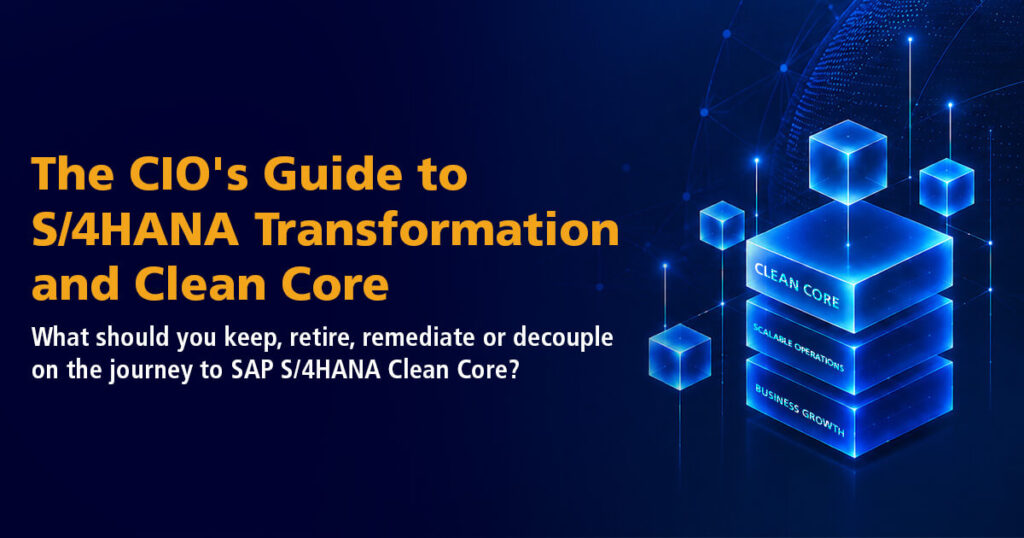
The CIO's Guide to S/4HANA Transformation and Clean Core
What should CIOs prioritise when planning an S/4HANA transformation? How can organizations address custom code, manage migration complexity and adopt a Clean Core approach without compromising business requirements?
Join our focused session for CIOs and SAP leaders to explore the challenges, considerations and practical approaches involved in S/4HANA transformation.
Register for the webinar: The CIO’s Guide to S/4HANA Transformation and Clean Core
Learn how to approach migration challenges, evaluate custom code remediation and build a more sustainable SAP landscape.