


The Burning Platform: Why Custom Code Is Slowing Down S/4HANA Programs
By now, most SAP leaders are aligned with the 2027 deadline. The most disruptive and less visible part is where the project is actually getting halted.
This is not because of infrastructure or data migration; it is due to custom ABAP code.
Throughout the ECC landscapes, custom code has been growing over the decades, it is structured with regional adaptations, business-specific logic, and workarounds which were not designed to scale. In many organizations, this converts into hundreds of millions of lines of code, frequently distributed across the systems.
Parallelly, nearly 85% of SAP customers are on ECC, mostly with migration programs either being delayed or not started. This leads to a capacity problem in the ecosystem, crucially it exposes a deeper issue: most organizations underestimate the efforts needed for dealing with custom code.
The cost of waiting leads to extended maintenance beyond 2027, which leads to financial burden, adding support costs, and not delivering any value.
This is the reason why custom code has become the defining driver deciding whether S/4HANA program would move forward or stop.
The SAP Standard Assessment: What the System Tells You
SAP provides a systematic starting point for custom code migration. When used accurately, it provides a clear, technical baseline of what requires change.
But the crucial point is how deeply teams use it.
Step 1: Custom Code Migration Worklist (SYCM)
The SAP Custom Code Migration Worklist is where most programs start. It is built on the Simplification Database. It detects which custom objects are impacted by S/4HANA transition.
At a surface level, it calls out:
- Incompatible objects
- Deprecated functions
- Simplification items affecting custom logic
But in real projects, running the worklist alone creates challenges.
Experienced teams stack this with usage data, typically from UPL or SCMON, to understand which objects are actually active in development. When done correctly, it is common to eliminate 40-60% of custom objects before remediation begins.
This one step changes the scale of the problem entirely.
Step 2: ABAP Test Cockpit (ATC)
Once the scope is defined, the ABAP Test Cockpit (ATC) becomes the primary engine for technical validation.
ATC identify errors and categorizes it throughout various dimensions:
- Syntax incompatibilities with S/4HANA
- Direct database access issues
- Deprecated APIs and function modules
- SQL performance concerns
- Data model changes such as MATNR field extensions
In high-volume systems, ATC generates thousands or sometimes tens of thousands of findings.
What’s crucial is to understand is that most of these are technical compliance issues, often recurring and pattern based.
Step 3: Moving ATC into Continuous Execution
In mature delivery setups, ATC is not considered a one-time scan.
It is merged into:
- CI/CD pipelines
- Transport release workflows
- SAP BTP-based validation layers
This evolves remediation earlier in the lifecycle. Developers address issues at the point of change, rather than during centralized testing cycles.
It improves quality, but the core problem is still not solved.
Because even with better detection, the effort to fix remains largely manual.
The Remediation Execution Gap: Where Timelines Break
The remediation execution is where major S/4HANA program start to
This is where most S/4HANA programs start to evolve.
The execution slows down significantly, even if assessment is clear and finding is structured.
Manual remediation unveils various obstacles at scale.
Each ATC finding requires to be interpreted, fixed, tested and needs to be interpreted, fixed, tested, and transferred. Even when the obstacle is straightforward, the process repeats thousands of objects. Initial analysis phases may take up to 6-8 weeks, often covering only a handful of systems.
And because many of these obstacles are variations of the same pattern, teams end up solving the same problem repeatedly.
The impact is anticipated:
- Timelines begin to stretch
- Costs increase beyond initial estimates
- Developer bandwidth becomes a constraint
- Quality varies across teams
This is the execution gap. This is a lack of scalable remediation.
Visual Workflow: End-to-End Custom Code Migration Pipeline
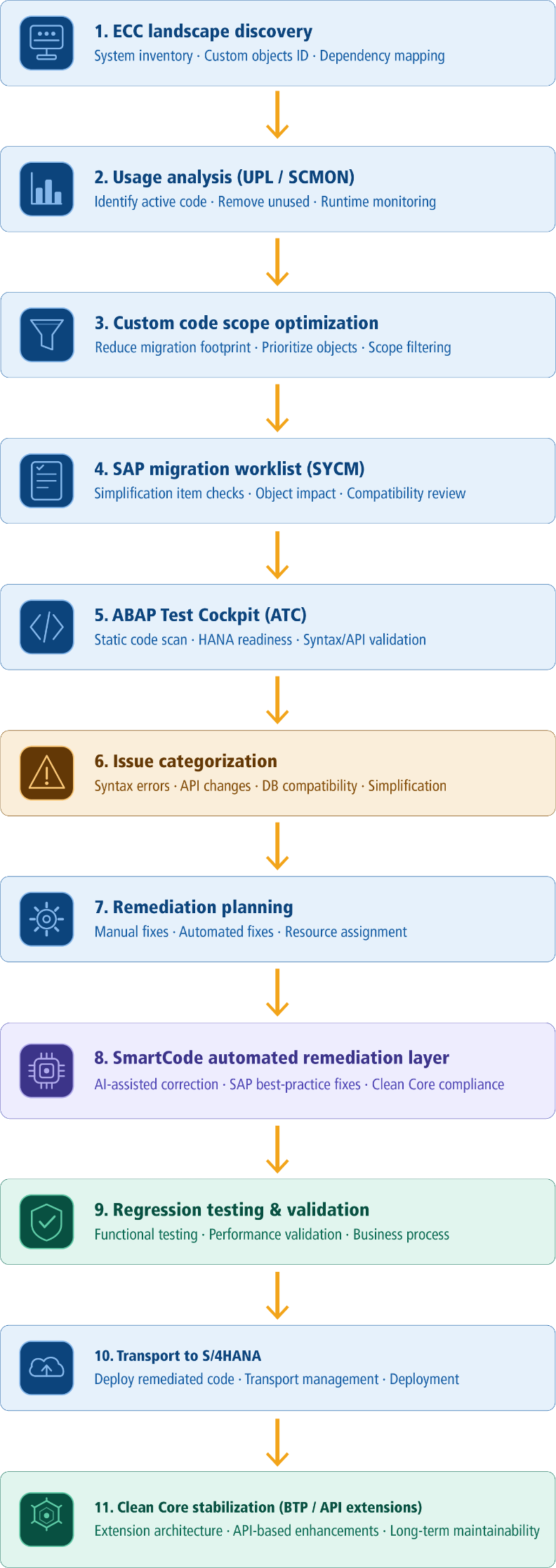
The SmartCode Solution:
Diligent’s SmartCode, a part of the Smart Custom Code Migration (SCM) platform, is built to close the execution gap in SAP S/4HANA custom code migration. Instead of addressing the SAP outputs like ATC outcomes and worklists as static reports, it turns them into an automated, structured remediation pipeline.
At its core, SmartCode executes across three clear layers of execution:
1. Input Layer: Assessment Ingestion
The process starts by ingesting SAP-native assessment outputs, including:
- ABAP Test Cockpit (ATC) findings
- SAP Custom Code Migration Worklist (SYCM)
- Simplification item impacts and code usage context
This layer combines all impacted custom objects into a unified execution backlog, ensuring no dependency or violation is missed during migration planning.
2. Transformation Layer: Automated Remediation Engine
Once the scope is defined, SmartCode applies rule-based automation to execute ABAP remediation at scale.
This includes:
- Syntax corrections aligned with S/4HANA standards
- Replacement of deprecated APIs and function modules
- Structural updates required for SAP data model changes
- Optimization of database access patterns and SQL logic
Instead of manual ABAP adjustments across thousands of objects, SmartCode applies consistent, repeatable transformation rules, reducing dependency on developer bandwidth and eliminating repetitive correction cycles.
3. Validation Layer: Testing, Regression & Traceability
After remediation, SmartCode ensures system stability through automated validation mechanisms.
This layer covers:
- Automated unit and regression testing of modified objects
- Validation of functional integrity across impacted modules
- Generation of structured documentation for every change
- Full audit traceability aligned with enterprise compliance requirements
This ensures that every transformation is executed, verified, and documented for governance and future reference.
Result: By connecting assessment, remediation, and validation into a single automated flow, SmartCode reduces manual remediation effort by up to 80%, enabling faster SAP S/4HANA migration while maintaining Clean Core compliance and technical consistency.
Conclusion
SAP S/4HANA custom code migration is an execution challenge defined by the ability to remediate large-scale ABAP code within constrained timelines.
Traditional methods slow down at the remediation stage due to manual effort, repetitive fixes, and dependency on developer bandwidth.
Diligent’s Smart Custom Code Migration (SCM) approach, powered by SmartCode automation, shifts this model from manual execution to structured automation. By converting assessment outputs into executable remediation, it reduces effort, improves consistency, and accelerates delivery.
The result is a migration process that is both fast and structurally aligned with Clean Core principles and long-term SAP stability.